Project / Case study

Aperture Financial Intelligence

From market context to a research note you can inspect.

A financial research workspace I designed and built across Next.js and Go. Sources, uncertainty, and human judgment stay in view.

Visit Aperture
Role
Product design + full-stack engineering
Year
2026
Experience
Live product preview
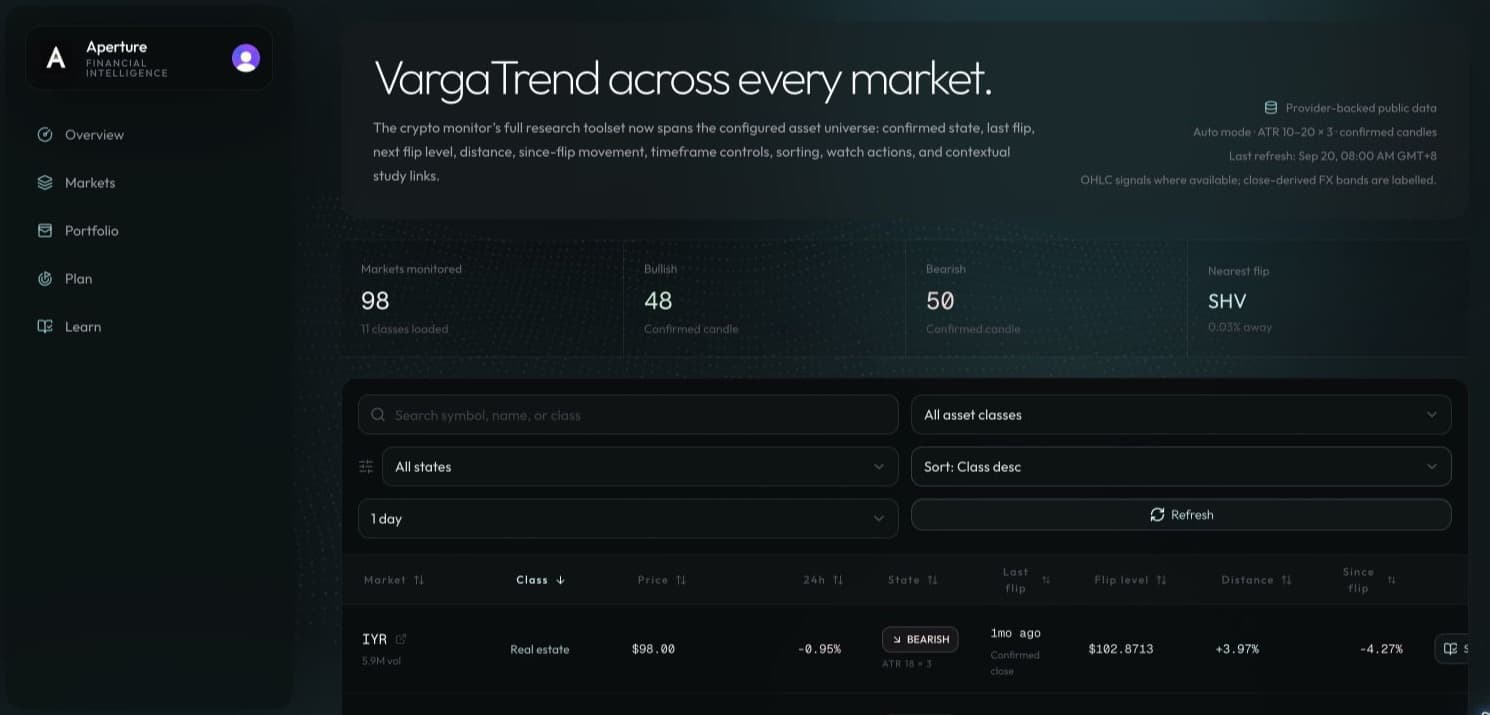
Aperture Markets workspace with cross-asset research context and five primary destinations
Markets, one of five connected workspaces. Historical product capture; figures are not current quotes.

A chart shows a price.
It doesn鈥檛 explain the picture.

A price chart cannot explain a portfolio, and an AI answer is hard to trust without its source. Aperture brings both into a research workflow people can inspect.

I organized the product around five jobs: Overview, Markets, Portfolio, Plan, and Learn. Research tools live where the question arises.

For individuals researching holdings, checking sources, and comparing scenarios.

Follow the work,
from question to judgment.

Choose a stage to see the interface and the decision behind it.

Aperture cross-market monitor showing provider-backed market states, freshness, filters, and research controls
Web workspace capture 路 market values are a historical snapshot.

Find what deserves a closer look.

Filter across asset classes, inspect the confirmed trend, then open a study with the market context still attached.

Why I designed it this way

Freshness, provider coverage, and closed-candle confirmation sit beside the numbers. A market state is research context, never an instruction to trade.

The product kept growing.

Recent implementation adds geography, quieter monitoring, and a mobile companion.

Show where the data places an asset.

The new investment globe connects portfolio holdings and market results to provider geography. A complete breakdown keeps global and unknown locations visible.

Interactive explanation of the implemented grouping rules. These are illustrative cases, not portfolio data.

Country linked

A provider country code can place an asset on the globe. The label preserves whether it describes an issuer or listing location.

A location lens, not a claim about economic exposure.
A digest when something changes.

Opt-in daily or weekly summaries select confirmed flips on closed daily candles. Users choose direction and delivery channel.

  1. Candle closes
  2. Flip confirmed
  3. Matching digest

No matching flip means no message. Email delivery depends on server configuration; source freshness and coverage gaps travel with the digest.

Carry the context into mobile.

An Expo / React Native companion now shares the backend contracts and Clerk identity with the web workspace.

  • Overview and portfolio context
  • Markets and asset detail
  • Digest inbox and preferences

Early implementation, not a store release. Push delivery, device verification, and full web parity remain ahead.

A calm surface.
Clear responsibilities underneath.

The interface can ask a question. The backend decides which data it is allowed to use.

  1. Next.js

    Product UI, same-origin APIs, AI streaming, and review interactions.

  2. Go

    Ownership checks, market normalization, portfolio calculations, and document APIs.

  3. Postgres + private storage

    Source documents, retrieval, persisted runs, and the human review ledger.

Verification

The recorded evidence baseline: 40 of 40 regression cases across five source documents.

Citation trust, injection, unsupported claims, schemas, and advice boundaries. Recorded source-repository evidence; these product checks were not rerun for this portfolio update.

What you can try

The public preview shows the product direction. Private workflows need configured services, sign-in, and your own source material.

External AI calls are disabled by default. The verified research path uses deterministic generation.

Implementation evidence and release boundaries

Recorded checks

  • The recorded evidence baseline passes 40 of 40 regression cases across five source documents: citations, injection, advice boundaries, unsupported claims, and schema validity.
  • The recorded disposable-database check covers private upload, retrieval, human review, and reviewed Markdown export.
  • Go tests, production builds, ownership checks, accessibility contracts, and deployment checks are documented in the source repository.

Limitations

  • The public preview shows the product direction. Private finance and research workflows require configured services, sign-in, and user-supplied data.
  • External model calls remain disabled by default; the verified research baseline uses deterministic generation.
  • The Expo companion implements Overview, Markets, and Inbox. Device release, push delivery, and full web parity remain future work.
  • Research and educational decision support only, without crossing into trade execution or personal advice.
MoreCurrent case studies

Explore the other current projects where product thinking is carried through interface, architecture, testing, and release.